Day 14 – The drive to Teotihuacan
We forgot to crack the windows last night so we awoke in our parking spot at the gas station to condensation-laden windows. We’ll try not to forget that again!
We cooked muesli in the van while in bench mode for breakfast and then set off for the all-day drive to Teotihuacan (maybe around 7 hours driving). The road brought us into the state of Mexico (the general area surrounding Mexico City), which included a huge number of tolls (maybe totaling $30 for the day). It also brought us to our first encounter with the police.
The speed limit has generally been 120km/hr for most of the paid-for highways. We generally set cruise control on at 90km/hr so as not to destroy the car when we hit potholes and to give us a bit better fuel efficiency. Little did we know that as soon as we passed the first toll booth into Mexico state, the speed limit changed to 80km/hr and there was a convenient smooth downhill with a police radar check at the bottom. We were pulled over and told that we would need to pay a 5000 peso fine ($250), and I could either pay it there in cash or he would take my drivers license and I would need to pay the fine in Mexico City to retrieve it. I resisted, and that’s when things became a little suspicious. He said that if we paid in cash there that he would lower it to 3000 pesos, then after a while 2500. Fortunately, all we had on us in cash was 200 pesos. After a long while, I remembered that we had 25 euros in a camera case, so after first asking what a “euro” was and how much it was worth, he grudgingly accepted and let us free. On asking locals later on, they said that this was normal, but we shouldn’t pay more than 300 pesos ($15).
We eventually arrived at Teotihuacan around 6pm and stayed at the Posada Sol y Luna hotel (we bargained down the price from 580 to 400 pesos [$20]). There was a nice market where we went for dinner, having 4 tacos each for 50 cents a taco.
Day 15 – Teotihuacan
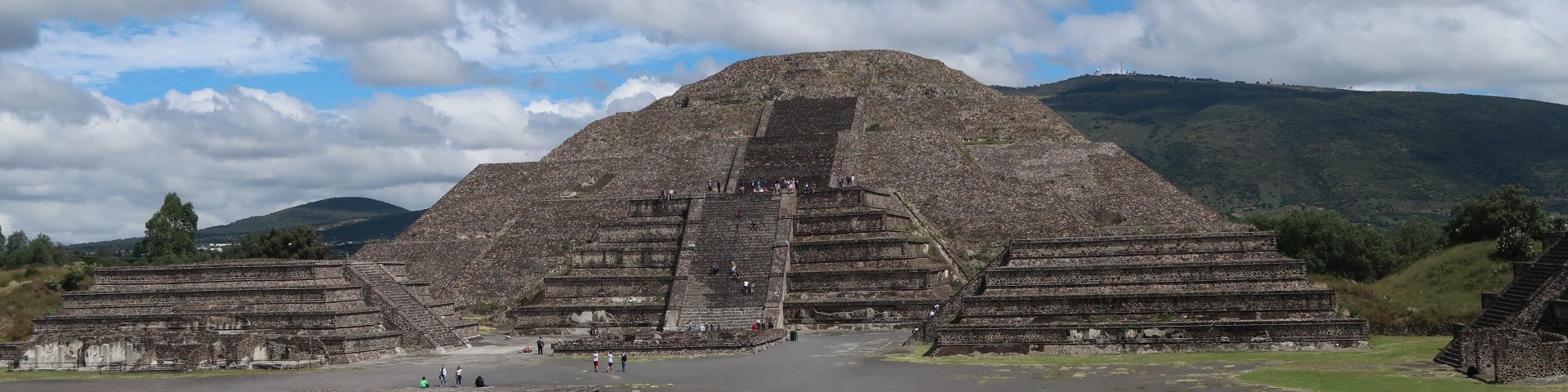
Teotihuacan is the site of an ancient civilization that was the largest city in the pre-Columbian Americas, with a maximum population of 125,000. It was neither Aztac nor Maya, but it’s own culture, around the period 250-750 AD. The site included the Pyramid of the Sun (third largest pyramid in the world), the Pyramid of the Moon (slightly smaller than the first), and the Temple of Quetzalcoatl, smaller, but more ornate.
We paid the 70 peso entry ($3.50) and began our day exploring the site. Starting with the Pyramid of the Sun, we climbed the 248 stairs to the top. It was pretty incredible to think about how it had been restored over the last century. When found, there was severe erosion and vegetation growing, but this had been tamed to bring it back to its former glory. A key aspect of pyramids of this style in Mesoamerica is that they were generally used for religious ceremonies, most notably a huge amount of human sacrifice. Preferably prisoners from other tribes would be sacrificed, but if there weren’t enough, warriors themselves of the Teotihuacan would be sacrificed. They believed that this was required to bring back the sun, especially in the winter as days grew shorter. As each year passed and they found that the sun did indeed return after the sacrifices were made, they believed that this was required for all future years.
Next up was the Pyramid of the Moon, with very steep stairs going up. It was quite similar to the first pyramid, but gave nice views along the whole “Avenue of the Dead” that ran the 2km along the center of the site. We continued to the museum, where we saw a lot of interesting pottery, sculptures, tools, and decorated skeletons (surprisingly not very protected from visitors). Lastly, we went to the smaller Temple of Quetzalcoatl, which had impressive heads carved alongside the staircase, alternating between serpents and “Tlaloc” creatures. Before departing we did some haggling for souvenirs and bought a pair of obsidian carved sun and moon deities along with a sombrero for Viki.
We rounded off the day by having a late lunch of sopes and quesedillas from the market, Viki did her Canadian permanent resident application, and we finished things off with a dinner of tamales. We had a nice chat with the vendor man [see photo], give him a small tip at the end, and he ended up giving us a rather large sample of a beverage called “atole” to bring home (basically hot chocolate, made from corn).